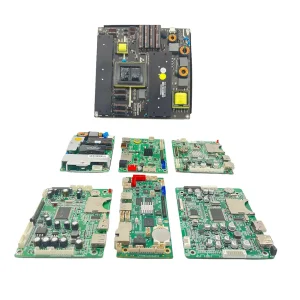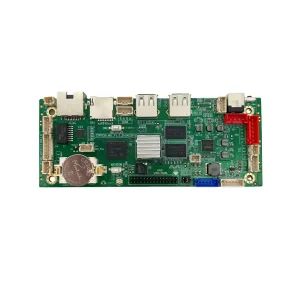
Precision PCBA Assemblies & Reinforced Electronics
Direct from our Shenzhen SMT intelligent assembly base: full traceability, closed-loop DFM validation, and structural backing for high-density component architectures.
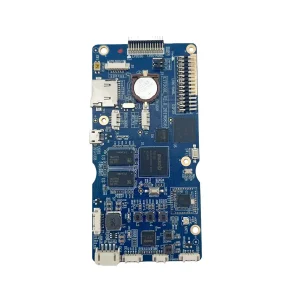
Engineering Principles of Component Area Stiffening
Flexible circuits possess dynamic routing advantages but lack mechanical rigidity under solder joints. Without localized stiffening, cyclic thermal expansion and mechanical flexing induce high peel stresses at the pad-solder boundary, precipitating pad liftoff and solder fatigue.
FR4 Dielectric Stiffeners
Standard glass-reinforced epoxy matrix (Tg 140°C–170°C). Implemented under fine-pitch BGA, micro-controllers, and terminal blocks to establish flat coplanarity during SMT reflow and prevent flexural fatigue during mating cycles.
- Thickness range: 0.1mm to 3.2mm
- Cost-effective flexure suppression
- Applied via high-temp thermosetting adhesive
Polyimide (PI) Film Backing
Thermally matched aromatic polyimide film designed to increase insertion thickness for Zero Insertion Force (ZIF) connectors and gold-finger contacts without compromising overall flex radius.
- Precise caliper: 25μm to 250μm
- Dielectric breakdown: >5 kV/mil
- Preserves dynamic flex-life integrity
Metallic Heat-Dissipating Plates
Precision CNC-milled 5052/6061 Aluminum or 304 Stainless Steel bonded with thermally conductive prepregs. Engineered for high-power LED drivers, motor controllers, and automotive radar modules.
- Thermal conductivity: Up to 200 W/m·K
- Mechanical pull force: >1.5 N/mm
- Electromagnetically shielded grounding
| Stiffening Material | Young's Modulus (GPa) | CTE (ppm/°C) | Adhesive Interface | Primary Industrial Use-Case |
|---|---|---|---|---|
| FR-4 Glass Epoxy | 22 - 24 | 14 - 18 | Modified Epoxy Thermal Film | SMT Component Zones, BGA Array Support, Relay Mounting |
| Polyimide (Kapton) | 3.2 - 3.5 | 20 - 30 | Pressure Sensitive Adhesive (PSA) / Acrylic | ZIF Connectors, Dynamic Hinge Zones, Pin Finger Backing |
| Stainless Steel (SUS304) | 193 - 200 | 17.2 | Conductive / Non-Conductive Epoxy | Ultra-thin high-rigidity wearables, tactile switch backplates |
| Aluminum Alloy (5052) | 70 - 73 | 23.8 | Thermally Conductive Prepreg | Automotive LED boards, EV BMS modules, high-current power stages |
Localized Deployment Scenarios for Rigid-Reinforced FPC
Across mission-critical verticals, structural component reinforcement enables compact flex circuitry to host heavyweight surface-mount devices without mechanical displacement.
Automotive BMS & Sensors
Reinforcing current-sense shunts, microcontroller arrays, and battery cell monitoring points within electric vehicle battery pack interconnects exposed to continuous road vibration.
Medical Diagnostics & IVD
Class III surgical devices, wearable patient telemetry monitors, and endoscopic camera tips utilizing localized SUS304 reinforcement for sub-millimeter component stability.
Industrial Robotics & Cobots
Dynamic multi-axis robotic joints requiring flexible conduits where control modules, encoders, and terminal interfaces are backed by thick FR4 stiffeners to prevent line strain.
Aerospace & Defense Avionics
Lightweight wiring harnesses incorporating localized structural aluminum pads, providing rigid solder land anchors that survive 20G sustained acceleration curves without trace rupture.
China Supply Chain Advantages in Precision Electronics
Situated in the center of Shenzhen's industrial corridor, our manufacturing infrastructure delivers rapid tooling, raw laminate access, and multi-tier component procurement unmatched by fragmented global supply chains.
1-Hour Sourcing Ecosystem
Direct physical access to copper foils, specialized adhesive films (3M, Dupont, Rogers), and active micro-components enables rapid prototypes within 48 to 72 hours.
Closed-Loop Quality Control
In-house laser routing, optical alignment for stiffener attachment, vacuum thermopress lamination, and automated 3D X-ray inspection for high first-pass yields.
Multi-Scale Scalability
Eight fully integrated high-speed SMT lines handling 1.2M+ placements per day. Smoothly scale projects from NPI pilot builds to million-unit production runs.
Technological Evolution of Stiffening Technologies
As microelectronics shift toward miniaturized heterogenous packaging, embedded silicon, and high-frequency millimeter-wave systems, component area stiffening is evolving from passive support to an active thermo-mechanical subsystem.
Vision-Guided Laser Placement
Moving beyond mechanical die-cutting to direct UV/Picosecond laser profiling with CCD visual alignment, reducing stiffener edge clearance down to ±0.05mm around SMT pads.
Embedded Vapor Chambers
Integrating micro-thickness copper and graphite vapor spreaders directly into the stiffener layer to draw concentrated heat away from AI accelerators and 5G RF transceivers.
Nanocomposite Ceramic Hybrids
Deploying ultra-low CTE silicon-nitride and ceramic-filled matrix stiffeners engineered to match low-k IC substrates and eliminate solder ball fatigue during thermal shock.
Active Structural Layers
Transforming mechanical stiffeners into functional sub-planes that integrate planar magnetics, capacitance arrays, and EMI shielding compartments within a single monolithic stack.
International Compliance & Engineering Support
Our localized support network ensures overseas clients obtain verifiable quality documentation, rapid DFM turnarounds, and cross-border logistics support.
Standardized Workmanship
Manufacturing adheres strictly to IPC-A-610 Class 2 and Class 3 standards, with full IPC-6013 qualification for dynamic flex circuitry and rigid-flex interface boundaries.
Environmental Compliance
100% RoHS & REACH compliant materials. Lead-free solder alloy management, halogen-free dielectric laminates, and zero hazardous off-gassing under high-temperature reflow.
Dedicated Engineering Desk
English-speaking SMT application engineers provide real-time DFM feedback, stack-up guidance, and test fixture designs to eliminate design loops prior to line-staging.
Component Area Stiffening: Technical FAQ
Direct engineering answers addressing critical design choices, tolerances, and production workflows for flex circuit stiffening.
Why is component area stiffening mandatory for BGA on FPC?
Ball Grid Array (BGA) components rely on uniform coplanarity across hundreds of solder spheres. Flexible polyimide laminates flex during thermal cycles or handling, imparting shear and tensile stresses that lead to micro-cracking and intermittent opens. An FR4 or metal stiffener mechanically decouples the BGA zone from flex stresses.
What is the standard tolerance for stiffener placement relative to pads?
Our standard visual/laser optical registration maintains a placement tolerance of ±0.10mm (±4 mils). For fine-pitch designs or space-constrained camera modules, we can achieve ±0.05mm (±2 mils) using CCD vision-assisted positioning and pre-cut acrylic bonding films.
How do you choose between Pressure Sensitive (PSA) and Thermoset Adhesives?
Pressure Sensitive Adhesives (e.g., 3M 467MP) are suitable for mechanical support not exposed to high heat (rated up to ~120°C). Thermosetting adhesives (modified epoxy or polyimide) are mandatory when stiffened assemblies must undergo reflow soldering (260°C peak), preventing delamination and adhesive outgassing.
Can stiffeners be connected to ground planes for EMI shielding?
Yes. By utilizing conductive adhesives or plating through-holes directly into Stainless Steel or Copper/Aluminum stiffeners, we create low-impedance ground connections that provide mechanical rigidity alongside robust Faraday-cage shielding against high-frequency RF interference.
Complete Production Lines Ready for Deployment
From rapid prototyping lots to steady mass manufacturing: high-speed SMT placement, automated inspection, and full lifecycle support under one purchase order.